Layers of Time: Historical Insights into Furniture Periods and Styles
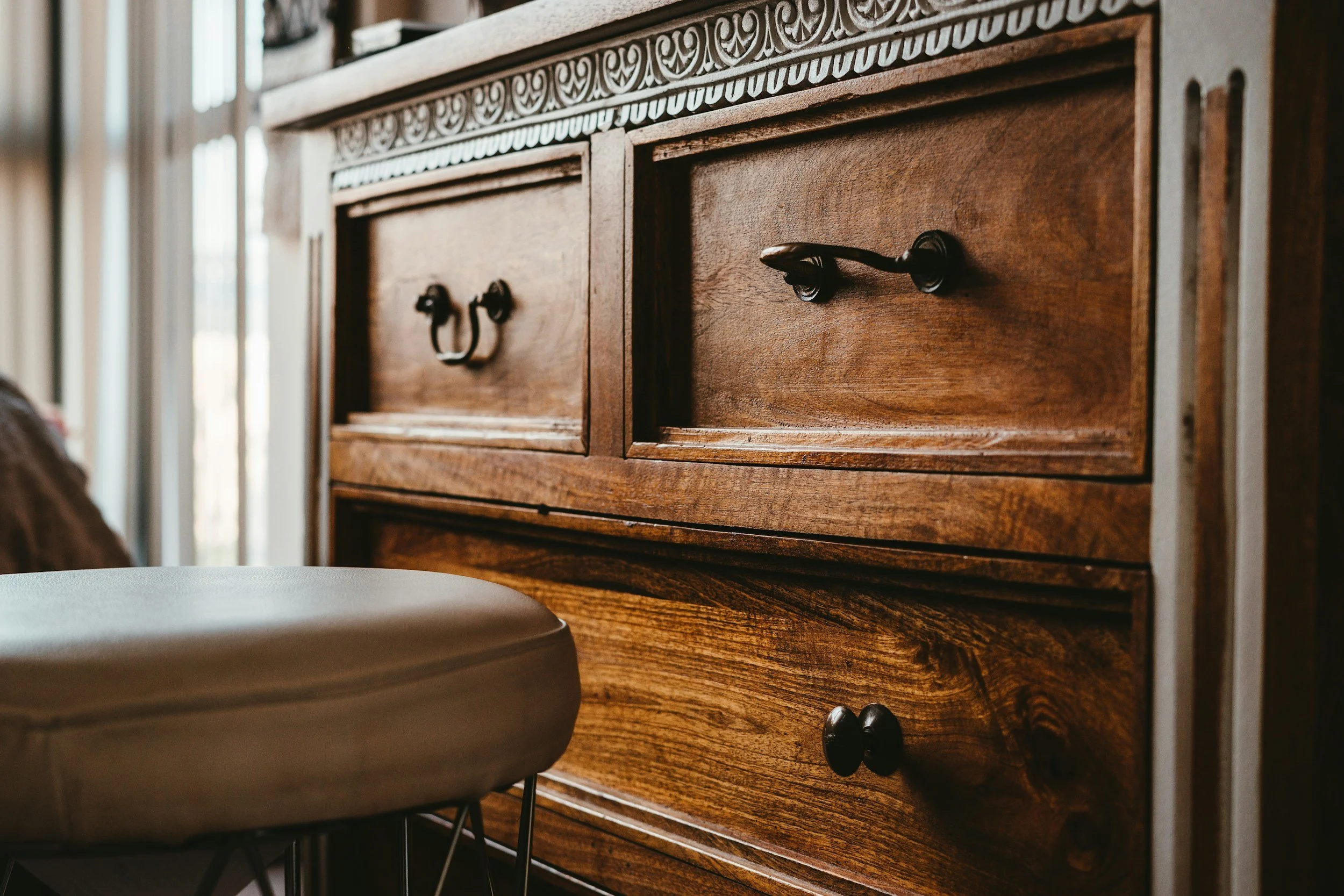
Furniture is more than function. It reflects culture, technology, and taste across centuries. If we look closely, each piece carries echoes of how people lived, worked, and decorated their homes. In this article, we trace major furniture periods and styles to show how design evolved through history and why these transitions matter to collectors and lovers of vintage furniture (1, 2).
Renaissance and Baroque: Early Structure and Ornament
The Renaissance period (15th–16th centuries) revived classical ideas of balance and symmetry in furniture. Craftsmen began treating furniture more like architecture, with proportion and classical motifs inspired by ancient Rome and Greece (1).
By the 17th century, Baroque style took hold. Baroque furniture was rich, bold, and expressive, with deep ornamentation and dramatic forms. These pieces often used high-quality wood and showcased the wealth and taste of their owners (2).
Transitional forms like the William and Mary style emerged in Northern Europe (1689–1702), blending English and Dutch influences with carved ornament and strong curves, marking a shift toward lighter and more refined forms compared to earlier heavy Baroque pieces (4).
Rococo and Neoclassical: Grace and Order
In the 18th century, Rococo furniture appeared, especially in France. It was playful and elegant, with curved forms, floral motifs, and a lighter feel compared with Baroque’s heaviness. The Louis XV style is a notable example, known for its asymmetry, comfort, and organic curves (1).
Later in the century, Neoclassical style drew inspiration from ancient Greece and Rome. Furniture became more restrained, with straight lines, classical proportions, and minimal ornamentation. These shifts reflected broader cultural moves toward clarity and reason (2).
Victorian Era: Eclectic and Elaborate (1837–1901)
The Victorian period overlapped with the Industrial Revolution. Furniture-making shifted from purely handcrafted to a mix of handwork and machine production. The result was an eclectic mix of styles, often drawing on earlier historical motifs like Gothic, Renaissance, and Rococo revival styles (6).
Victorian furniture is known for its ornate detail, large scale, and deep finishes. Dark woods like mahogany, oak, walnut, and rosewood were common. Upholstery was plush and decorative; chairs and sofas might feature buttoned leather or velvet. Tables and cabinets often had elaborate carvings and moldings (4).
This period also marked the rise of furniture production for a broader market. Pieces were more widely available because factories could produce them in larger quantities, yet quality still varied widely depending on maker and material (5).
Edwardian Era: Elegance and Transition (c.1890–1910)
Edwardian furniture represented a shift toward lighter forms and refined decoration compared with the Victorian heaviness. Craftsmen borrowed from earlier Georgian and classical traditions, incorporating cleaner lines, subtle inlays, and floral motifs (1, 2).
Edwardian pieces were often slimmer, more open, and suited to new domestic spaces that valued comfort and elegance. Woods like mahogany, walnut, and satinwood were still used, but in ways that emphasized lightness and proportion rather than decoration for its own sake (6).
Arts and Crafts and Art Nouveau: Handwork and Organic Forms
In the late 19th and early 20th centuries, the Arts and Crafts movement reacted against industrial mass production. Designers emphasized handcraftsmanship, honest materials, and simple forms. Furniture from this period often features oak or cherry wood with visible joinery and minimal decoration, celebrating the nature of the material itself (1).
At the same time, Art Nouveau brought nature’s lines into furniture design. Flowing curves, floral patterns, and asymmetry were common. Craftsmen embraced organic shapes and rare materials, and pieces were often handmade with a fine finish (2).
Art Deco: Glamour and Geometry (1920s–1930s)
After World War I, Art Deco became popular in Europe and the United States. This style embraced geometric shapes, bold lines, and luxury materials like lacquer, chrome, and exotic wood veneers. Furniture was sleek, elegant, and inspired by technology and modernity (1).
Mid‑Century Modern: Function and Simplicity (1945–1969)
Mid‑Century Modern design emerged after World War II and defined furniture aesthetics for decades. Characterized by clean lines, organic forms, and minimal ornament, this style emphasized practicality and comfort without sacrificing beauty (2, 3).
Designers like Charles and Ray Eames, George Nelson, and Eero Saarinen explored new materials like molded plywood, fiberglass, and bent metal, combining them with traditional woods for a balanced, human-centered design (3).
Contemporary Context and Lasting Influence
Today, furniture styles continue to evolve. Contemporary design often borrows from the past, blending minimalism, sustainability, and modular thinking. Many vintage styles are revived or reinterpreted in new ways, showing that historical insight remains relevant to modern tastes and interiors (1).
Understanding these periods and styles helps us recognize the quality, intention, and history behind the pieces we live with or collect. When a chair or table carries the marks of its era, it becomes more than furniture—it becomes a connection to the people who made and used it.
References
Hinchman, Mark. History of Furniture: A Global View. Bloomsbury Publishing, 2016, London, UK.
Oats, Joclyn M. An Illustrated Guide to Furniture History. Taylor & Francis Ltd / Routledge, 2021, London, UK.
Gura, Judith. The Guide to Period Styles for Interiors: From the 17th Century to the Present. Fairchild Books, 2017, London, UK.
Macquoid, Percy. A History of English Furniture. 4 vols., first published 1904–1908, UK.
Chinnery, Victor. Oak Furniture: The British Tradition. ACC Art Books, UK.
Payne, Christopher. British Furniture 1820–1920: The Luxury Market. ACC Art Books, UK.
